
Free Poison Prevention Material Downloads
Children

Quills Up-Stay Away! A Poison Awareness Program featuring Spike
Appropriate for daycare, head start, preschool, Pre-K, Kindergarten
Quills Up--Stay Away! includes: an 11 minute puppet show video, a teacher's guide with classroom activities, and educational material to send home. If you would like to borrow the video or have poison prevention materials for the classroom, contact the Community Outreach Coordinator at (304) 347-1379.
Click on the links below to view materials and obtain free copies of the Quills Up! program materials.
Your comments and suggestions help us in developing educational materials. Please complete and return the Educator Survey. Fax to the West Virginia Poison Center at (304) 347-3908 or e-mail to cmcburney@hsc.wvu.edu.
*The Quills Up! materials are copyrighted by the American Association of Poison Control Centers and may be used, without edits/modifications, for poison prevention education.
This program was supported by Cooperative Agreement Number U50/CCU317503-03 from the U.S. Centers for Disease Control and Prevention. Its contents are solely the responsibility of the authors and do not necessarily reflect the official views of the U.S. Centers for Disease Control and Prevention.
Mr. Yuk Stickers

Teach your kids that Mr. Yuk Means NO! Place Mr. Yuk on all potentially harmful substances around the home or where children may venture. There are 12 Mr. Yuks per sheet with the West Virginia Poison Center's toll free number on each sticker.
West Virginia Poison Center Telephone Number Stickers
West Virginia Poison Center Telephone stickers. Don't fumble for numbers in an emergency. Place this sticker on each phone and be ready. Each strip contains 3 peel and stick stickers with the phone number for the WVPC.
What About Plants Brochure
Household plants have become one of the nation's leading causes of ingestions in children. The following lists are toxic and non-toxic plants. Since we cannot accurately identify your plants from a telephone description, it is important that you know the names of all the plants in your home and yard. If you do not know the name of a plant, you should have it identified by the nearest landscape or gardening center in your area.
Adolescents and Adults
Poisonous Snakes of West Virginia
Approximately 25% of all venomous snake bites do not result in envenomation. This means that the snake may bite, but not inject any venom.
Download Poisonous Snakes Pamphlet
Bites & Stings
Bites and stings usually occur during the warmer months, when the weather beckons most of us outdoors and increases our exposure to bees, spiders, and caterpillars. These insects use poisonous venom as a means to capture prey or to defend themselves or nesting areas. The West Virginia Poison Center is available 24 hours a day to help you if a bite or sting occurs.
Download Bites and Stings Pamphlet
Energy Enhancers
Caffeine is a stimulating drug that is used to increase energy, enhance mood, and delay sleep.
Download Energy Enhancers Pamphlet
Inhalant Abuse
It can kill suddenly, and it can kill those who sniff for the first time. Every year, young people in the country die of inhalant abuse. Hundreds also suffer severe consequences, including permanent brain damage, loss of muscle control, and destruction of the heart, blood, kidney, liver, and bone marrow.
Download Inhalant Abuse Pamphlet
What Parents Should Know About Jimson Weed
Jimson weed is also known as: Datura Stramonium, thornapple, stinkweed, Jamestown-weed, Stramonium, Datura, Devil's Apple, Devil's Trumpet, Apple of Peru, Mad Apple, and Tolache.
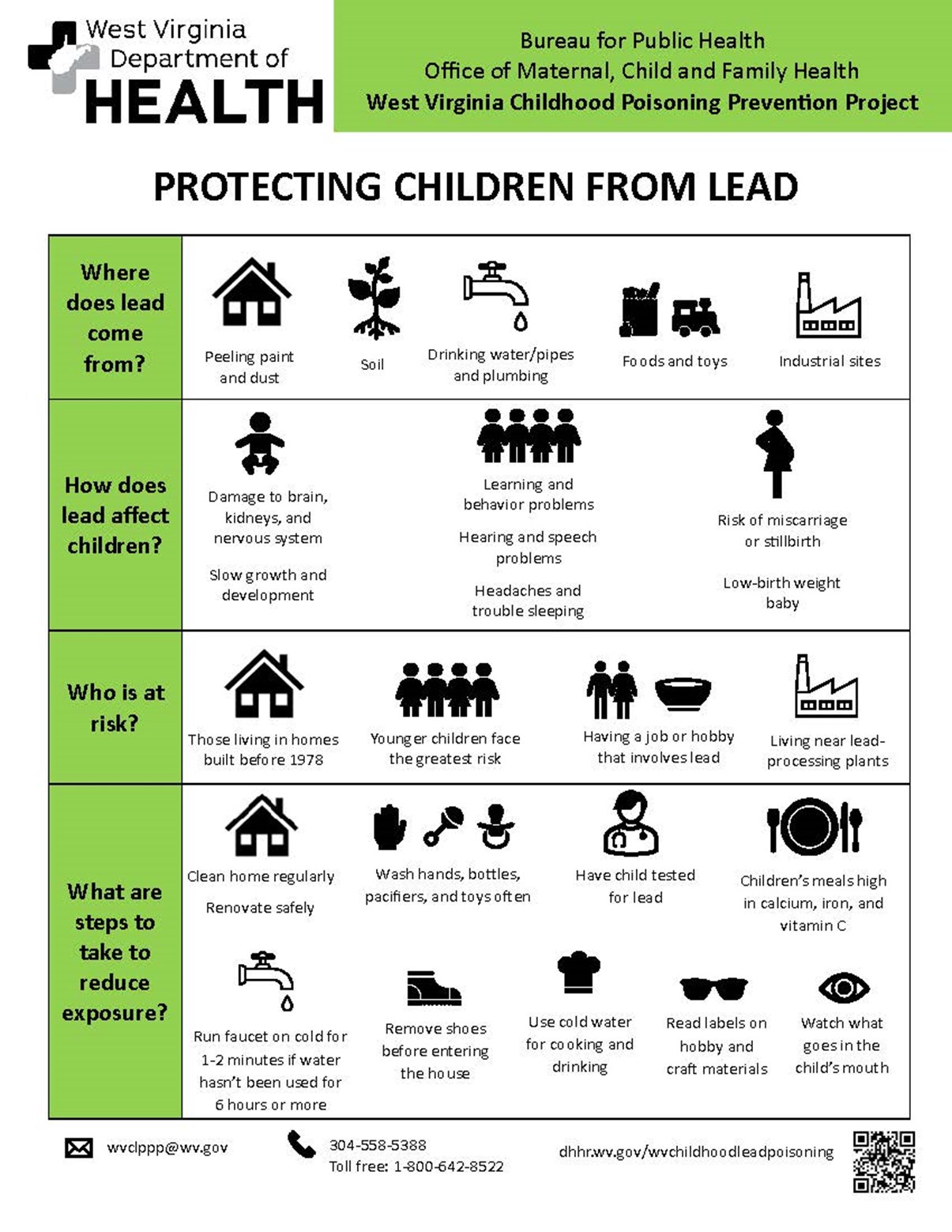
Hobbies & Lead Poisoning
Hobbies and what you should know to keep your family safe from the dangers of lead poisoning.
Download Lead Poisoning Pamphlet
Carbon Monoxide
Carbon monoxide is the leading cause of accidental poisoning deaths in America.
This is an updated version of a brochure originally produced through a collaboration between the West Virginia Poison Center and the West Virginia University Center for Rural Emergency Medicine (WVU-CREM). The CREM has since been subsumed under the WVU Injury Control Research Center (ICRC) (www.hsc.wvu.edu/icrc), which has kindly supported our use of some of the original content in the current version. The WVU-ICRC is funded by the Centers for Disease Control and Prevention (CDC) to advance the science and practice of injury prevention and control through research, education, outreach and service.
Download Carbon Monoxide Pamphlet
Pool Chemicals
Individuals can experience severe injuries caused by pool chemicals.
This is an updated version of a flyer previously produced by the West Virginia Poison Center.
Download Pool Chemicals Brochure
Pets & Poisons
Dogs, cats, and other animals are curious, a natural behavior that places your pets at risk of being poisoned. Many things in your home may be poisonous to your pets. You can help keep your pets safe by storing and using poisons safely.
Download Pets and Poisons Pamphlet
Letter to Grandparents
Do you use any prescription, or over-the-counter medicines? Did you know that one third of the poisonings reported among children under age six are from prescription drugs commonly used by older adults (high blood pressure pills, heart medicines, etc?) In fact, many childhood poisoning deaths result from eating a grandparent’s medications. This happens at both the child’s home and the grandparent’s home.
Download Medication Safety Information
Posters
Need a Speaker?
The WVPC also has a Community Outreach Coordinator who would be happy to help. The Community Outreach Coordinator travels throughout West Virginia. The coordinator delivers speeches and presentations to a wide range of age groups concerning a variety of poisoning topics to meet your needs. The presentations are informative as well as entertaining as displays, puppets and household products are used as props to get this very important message across. Health fair participation gives the public an opportunity to ask questions about the display, props and brochures as well as concerns about poison prevention.
The Coordinator covers the whole state of West Virginia. A minimum of 3 weeks notice is suggested. Dates are scheduled on a "first come, first serve" basis. If you would like to schedule or talk to the coordinator concerning your group or organization, please contact the Coordinator, Carissa McBurney.
Since it is impossible for one person to educate the entire state about poison prevention, the WVPC is developing a network of volunteers to assist the Coordinator in delivering the poison prevention message. Your assistance would be appreciated. These "Poisonteers" will assist the Coordinator by delivering presentations and attending health fairs in their community. The WVPC will provide materials and support to these volunteers. If you are interested in learning more about our "Poisonteer" program please contact the Community Outreach Coordinator, at (304) 347-1379.